
A Self-Guided Tour of the Church
Please use this guide to explore some of the significant architectural, artistic and liturgical features of this historic place of worship.
A Brief History
St. Thomas’s parish was established in 1874 to serve the residents of Seaton Village, northwest of Bloor and Bathurst streets. In 1882, the original building on Wells Street was split into two parts and transported on rollers to the southwest corner of Huron and Sussex streets. Our present building, which was originally intended to be a temporary structure, was built in only nine months and dedicated on January 17, 1893. It was designed by architect Eden Smith (1859–1949), a long-time parishioner, who is credited with bringing the Arts and Crafts movement to Canada. Eden Smith and several other parishioners, including heraldic artist and calligrapher A. Scott Carter, had a lasting impact, not only on the parish, but also on the city. Smith’s works include churches, libraries, the Bain Co-op, the Studio Building, the engineering residence at the University of Toronto (now the Graham Library and the Munk School of Global Affairs), as well as many homes in Wychwood Park and other neighbourhoods.
The elegant simplicity of Smith’s design provides the backdrop for many visual enhancements added over time. These gifts add to the sensory and spiritual richness of the liturgy, and are significant to the social history of the parish, commemorating individuals and families who have worshipped here. The stained-glass windows are among the best 20th-century glass in the country, much of it produced by the Toronto-based Robert McCausland studio (the oldest in North America), as well by individual artists. The baptistery windows are the only non-Canadian glass in the building, and were created by A.J. Davies of the celebrated Bromsgrove Guild in England.
Changes to the Building
In 1917, the chancel was extended eastward 24 feet (from the current communion rail to the east end). Both the Lady Chapel (Carter) and the baptistery (Smith) were completed in 1922. Additional interior alterations to the church were made in the 1960s and 1990s, including the relocation of the rood screen (to the narthex), and the installation of a tile floor, greatly enhancing the building’s acoustics.
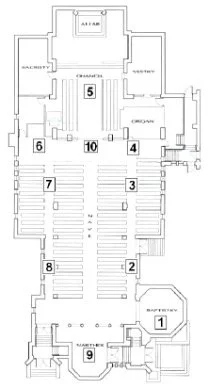
1 | Your tour begins in the baptistery. Baptism is the sacramental entry into the Church, and the baptismal font is traditionally placed near the entrance to a church. This octagonal baptistery (1922) was created by Eden Smith to commemorate the 35 parishioners killed in the First World War.
The five twin-light windows were created in the early 1920s by A.J. Davies of the Bromsgrove Guild in England. They reveal the lingering influences of English Pre-Raphaelitism, and are worked in an anachronistic style pre-dating the Arts and Crafts movement. More information on the Bromsgrove Guild can be found on a separate card.
Although it is not known for certain, the woodwork and the Christus Rex (Christ the King) that hangs on the back of the baptistery were probably designed and executed by parishioner A. Scott Carter, whose work can be seen throughout the church (for example, the reredos and the canopy over the Lady Chapel). Regarded as Canada’s foremost heraldic artist, he also created the heraldic decoration in the Great Hall at Hart House.
Along the top of the woodwork is a gently adapted quotation from Samuel Taylor Coleridge:
How well [they] fell asleep! / Like some proud river, widening toward the sea; / Calmly and grandly, silently and deep, / Life joined eternity.
The bronze font canopy was a gift from parishioner Gerald Larkin, the most generous benefactor both of the parish and of Trinity College. The canopy appears to be an amalgamation of two parts, the upper part including figures of Spanish saints. Canada House in London’s Trafalgar Square was a gift to Canada from Larkin’s father, Peter, who served as high commissioner. He had prospered as the owner of the Salada Tea Company, creator of the teabag, which Gerald later ran. There is a separate baptistery brochure for those wishing to know more about this exquisite space.
2 | Leaving the baptistery and walking up the side aisle, you pass a small lancet window (McCausland, 1959) portraying St. Aidan. He founded the monastery at Lindisfarne in northeast England in the early 7th century, re-establishing the Church where Christianity had largely disappeared following the withdrawal of Roman troops (ca. 400 AD). Although it is among the newest windows in the church, it is based on traditional McCausland design types.
3 | Entering the south transept, you will notice under the windows several memorial plaques commemorating the lives of the late rectors and vicars of the parish.
a) The small window depicts events and figures symbolic of the founding of the Anglican Church in Canada, including Bishop Charles Inglis, first bishop of the Church of England in North America. This window dating from the early 1960s is of a contemporary design by Yvonne Williams, one of Canada’s leading stained-glass artists.
b) The next window (McCausland, 1930s) portrays St. Edith of Wilton, the illegitimate daughter of King Edgar of England and of St. Wilfrida, a nun whom King Edgar had abducted.
c) The impressive triple-lancet window (McCausland, 1906) depicts the Ascension of Our Lord in the upper section of the central window. His watching disciples span all three windows. It was given in memory of Fr. Edward Ley King, in whose honour the Lady Chapel was created.
d) Above the holy water stoup is a bronze sculpted face of Christ as the Man of Sorrows. It was crafted by parishioner Joseph M. Stultiens, whose works, including the lectern (4b) and pavement lights (5e), you will see elsewhere in the church.
4 | Continuing toward the choir past the organ chamber:
a) The organ (Guilbault-Thérien, Opus 37), was installed in 1991. Consisting of nearly 3,000 pipes, the organ incorporates pipe work from a Samuel Warren instrument built in 1893, as well as from rebuilds by Casavant Frères in 1911 and 1955. This chamber contains all of the pipes except the electronic 32-foot pipe (2004) and the “trumpet” stop (2007), the latter housed in the north chamber across the chancel. On the organ case is a plaque listing our many fine music directors over the years. More information on the organ is posted on the wall.
b) The bronze angel lectern, fondly referred to by parishioners as “Matilda,” was installed in 1917. It is said to have been modelled after the then-rector’s daughter, Hyacinth. It was designed by Joseph M. Stultiens and cast by T. F. McGann & Sons of Boston, where Stultiens lived for a time.
5 | Entering the choir, you will see one of the glories of the church – the reredos behind the High Altar. First installed in 1906 in a plainer form, it was embellished in 1942. A. Scott Carter (designer and painter), Edward Watson (carver), and William Rae (consultant) all worked on the project. These three artists, together with Eden Smith, were members of the Arts and Letters Club of Toronto, where their heraldic arms are still displayed.
Across the top of the reredos are, in Latin, the first words of one of the most familiar passages of Scripture, which translate as God so loved the world. The passage continues, that he gave his only-begotten Son, that whosoever believeth in him should not perish, but have everlasting life. (John 3:16).
The nine statues in the reredos were carved by Watson in his Sherbourne Street studio over a period of two years. Each statue is 34 inches in height and made from a single block of Western Canada pine. The nine figures are:
St. John the Baptist | St. James the Great | St. Augustine
St. Cyprian | St. Thomas | St. Hilda of Whitby
St. Michael the Archangel | St. John the Evangelist | St. George of Cappadocia
More information on the Reredos can be found on a separate card.
Other points of note in the chancel include:
a) The Crucifixion window (McCausland 1913), with Mary Magdalene at the foot of the Cross – south side.
b) The Adoration of the Magi window (McCausland 1913) – north side.
c) The sanctuary lamps, which date from 1899.
d) Two of the candlesticks behind the High Altar date from the 17th century and were purchased in 1906 from Berkentin & Krall in London.
e) The two large brass pavement candlesticks date from the early 1920s.
As you leave the chancel, the north organ chamber is to your right. It was decorated by parishioner Robin Kingsburgh, a professor of astronomy and art, who curated several installations for the parish’s participation in Nuit Blanche. “The Comet” incorporates several design elements from the church interior, particularly the roof trusses. The chamber houses the “trumpet” stop, the most recent enhancement to the organ, as well as our state-of-the-art livestreaming and sound booth.
6 | Past the pulpit on your right is the Lady Chapel (referring to the Blessed Virgin Mary), built in honour of Fr. Edward Ley King, who was killed in the 1906 rail disaster in Salisbury, England. By coincidence, four other priests from St. Thomas’s were in England at the same time and attended his funeral. The canopy, by A. Scott Carter, was completed in 1922. The Ascension window in the south transept was installed in Fr. King’s memory. He is also commemorated in Salisbury Cathedral.
The triptych over the altar depicts in its central panel the Virgin and Child, with St. Thomas kneeling at their feet with a model of our parish church in front of him. The left panel depicts John Charles Roper, who was vicar of our parish from 1888 to 1897 and who is responsible for the theological and liturgical pattern of the parish. He was later elected Bishop of Ottawa. Scenes of Ottawa, including its Christ Church Cathedral, are shown in the background. The right panel portrays Hannah Grier Coome, a parishioner who, after being widowed, became the Mother Foundress of the Sisterhood of St. John the Divine. The old convent and St. James’ Cathedral are in the background. The triptych was painted by parishioner Dr. Suan-Seh Foo and installed in 1996. More information on the triptych is found on a separate card.
The elaborate canopy above the altar was designed by William Rae and executed by A. Scott Carter in 1922. It depicts the seals of church organizations associated with the parish, and the personal seals of past vicars and the bishop of the diocese, alternating with fleur-de-lys.
To the left of the altar stands a statue of the Madonna and Child, given to the parish in 1985.
7 | The triple lancet window in the north transept depicts Christ in the central pane (McCausland, 1905), St. Peter to the left (McCausland, 1906) and St. Thomas to the right (McCausland, 1906). The Christ window was originally installed on the east wall, where the reredos is now located, before being moved to its present location.
To the left are a single lancet (McCausland, 1948) of Simeon in the Temple with the infant Jesus, and the Education of the Virgin by St. Anne, created by Yvonne Williams in the early 1960s. Like the corresponding window in the south transept, it is of modern design.
8 | As you continue along the north aisle, you will see two small windows produced by Rosemary Kilbourn in the 1970s. Quotations from T.S. Eliot’s Four Quartets are inscribed beneath each of the beautiful abstract designs.
Next is a window commemorating St. Ninian (McCausland, 1959), who along with St. Aidan (commemorated in the south aisle) helped to re-establish Christianity after the Roman withdrawal in the 5th century. St. Ninian focused his mission in southern Scotland.
9 | The five-sided narthex was significantly altered in the early 1960s when the parish received a bequest from Gerald Larkin, a parishioner from childhood and generous benefactor. Among the changes: The rood screen (rood = cross) was moved here, having originally separated the nave from the choir; panelling and lighting were added to what had been bare brick walls; and the blue baize doors were installed. The main doors of the church were also created at that time.
The statue of Our Lord,which was carved in Oberammergau, Germany, in 1911, was originally mounted in the centre of the old reredos behind the altar. The statue was moved to this location in the 1940s.
The angel musician windows are by McCausland. The two outer ones date from 1909, and the two central ones from 1955. The quotation is from the Gospel of Matthew – Their angels do always behold the face of my Father which is in heaven – which is the traditional gospel reading at infant baptisms, and therefore appropriate when the baptismal font was located here prior to 1922.
10 | Looking toward the altar, you see the rood beam, under which the rood screen originally stood. On top of the beam is the figure of Christ on the Cross, with the Blessed Virgin Mary and St. John on either side.They were carved in Oberammergau and installed in 1911.
We hope that you have enjoyed your visit to Saint Thomas’s. Before you leave, please take the opportunity to spend a moment in prayer or contemplation, giving thanks for the generosity of the many people who have, in large and small ways, made our parish church one of beauty, glorifying God in works of art and in service to our community.
About the Parish
St. Thomas’s was a product of the 19th-century Anglo-Catholic movement, also known as the Oxford Movement, which emphasized both the continuity of Anglicanism with the pre-Reformation Church in England, and the common heritage shared with the Roman and Eastern Orthodox Churches. The Mass (also known as the Eucharist, or Holy Communion) is the central act of worship, not only on Sundays, but every day of the week. Other features common to Anglo-Catholic parishes include the reservation of the Blessed Sacrament, the use of coloured vestments, and incense. Many of these features became mainstream in the Anglican Church in the latter half of the 20th century. Initially, they were considered radical and “papist.” In the early days, the parish was even physically attacked on more than one occasion by people of self-avowedly “low church” persuasion.
Today, St. Thomas’s remains liturgically distinctive within Anglicanism, as one recent trend within the broader Church has been toward more experimental liturgies. The language at most services remains the Tudoresque English of the Book of Common Prayer, and the ceremonial based largely on medieval English models. The 11:00 a.m. service on Sunday is a High Mass, meaning the Celebrant is assisted by a Deacon and Subdeacon. The 9:30 a.m. Sung Mass expresses Anglo-Catholic practices inspired by the ecumenically minded liturgical movement of the last century, which favours using modern language for both the said and sung parts of the Mass. Each exhibits a distinctive charism.
Music has always been an important element of the parish’s life, and our choirs sing settings from the 16th to 21st centuries. Since the founding of the parish, many of Canada’s best-known singers and organists have been trained at St. Thomas’s. Our choirs have won competitions, and have served as choir-in-residence at Canterbury Cathedral, Westminster Abbey, York Minster, St. Paul’s Cathedral, London, Salisbury Cathedral, and St. George’s Chapel, Windsor Castle.
The parish’s connections with the University of Toronto have been important from its earliest days, when John Charles Roper served as a professor at Trinity College. Our congregation today continues to include faculty, staff, students, and many others who first came here while studying at U of T and other area educational institutions.
Social outreach has been a significant part of the parish’s life. The parish founded the first woman’s shelter in the city, Humewood House, which continues to provide excellent services to those in need. The Friday Food Ministry provides a weekly meal to 80–100 people who are homeless, marginally housed, or experiencing food insecurity. The parish’s past support of refugees was revived in 2016, in conjunction with the Huron-Sussex Residents Organization. We have since welcomed refugees from Iran, Syria, Eritrea, Nigeria, and elsewhere.
Our Mission Statement
As an active and welcoming Anglo-Catholic parish rooted in Scripture, Reason, and Tradition, we worship the Lord in the beauty of holiness and witness to Christ through pastoral care, music, education, discipleship, and service.